
A richly decorated altar
Stylised flowers and plants and their natural forms are popular decorative motifs in churches and on ceremonial objects. In the seventeenth and eighteenth century, Catholic worship was confined to private houses. Being unable to channel their creativity into ornate, publicly visible churches, paintings and stained-glass windows, Catholics devoted extra attention to the altar. Silver and gold objects were especially popular as altar ornaments.
Ornaments
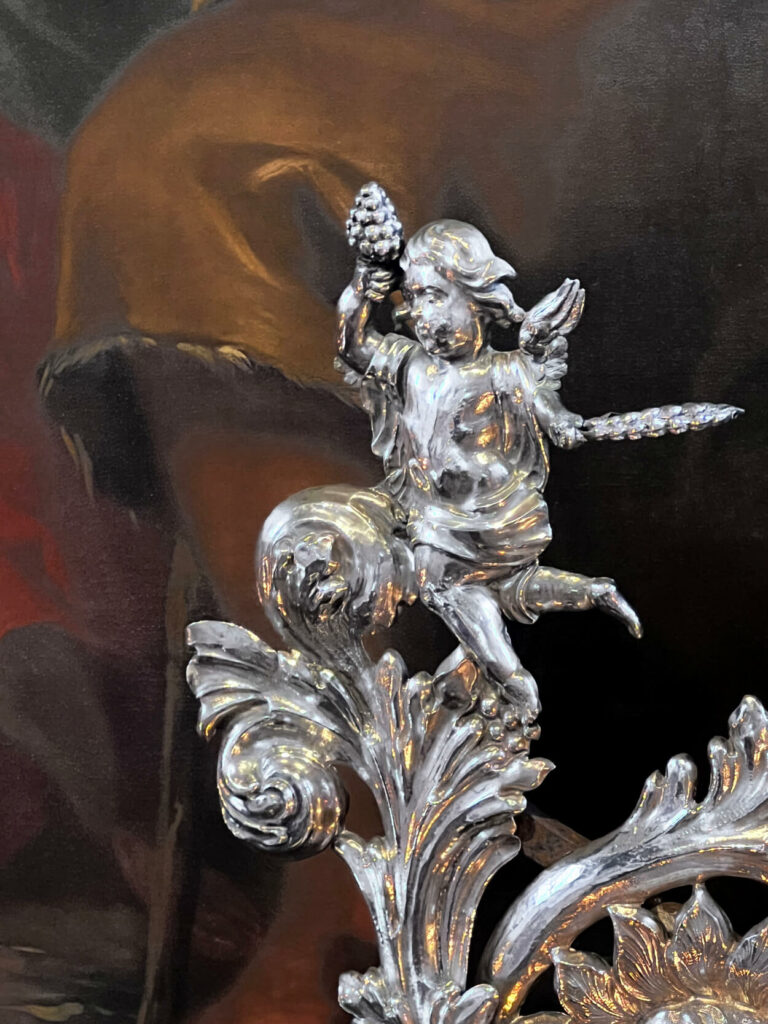
These richly decorated silver ornaments were designed to surround the tabernacle. The acanthus tendrils, leaning towards one another, emerge from a cornucopia: a horn of plenty bursting with fruit. Parrots perched on the tendrils are surmounted by sunflowers. Two putti (cupids) each balance on one foot while holding a bunch of grapes and an ear of corn on the right, The one on the left only has an ear of corn (Because the grapes have been lost unfortunately). The corn and the grapes symbolise the wafer and the wine that become the body and blood of Christ in the Catholic mass.
Sunflowers
Sunflowers turn towards the sun as it crosses the sky. And just as they follow the sun, the Christian soul follows Christ. In seventeenth-century books about the symbolic meanings of flowers, the sunflower is associated with a saying of Jesus: ‘I am the light of the world: he that followeth me shall not walk in darkness, but shall have the light of life.’ (John 8:12; King James version). The sunflowers on these altar ornaments lean towards the sacred hosts (the body of Christ) which used to be preserved in the tabernacle.
Parrot
Parrots represent eloquence. They often appear in the decoration on Baroque pulpits. The parrots in these altar ornaments appear to represent a symbolic ‘defence of the miracle of Mary’s chastity’. This symbolic attribution is based on an interesting reasoning involving a pelican and a snail as well as a parrot: ‘If a parrot is naturally able to say Ave, surely the chaste Virgin would have been able to bear a child following an Ave from Gabriel? If a pelican can bestow life to its young with its own blood, surely the Virgin with her pure blood would have been able to bear Christ? If a snail can be fertilised by the dew, surely the Virgin would have been able to give birth from the dew of the Holy Spirit?’ These and a series of similar reasonings appear in the book Defensorium Immaculatae Virginitatis authored by the fourteenth-century Dominican Francesco de Retza (c. 1343-1427).